THE SHORT ANSWER
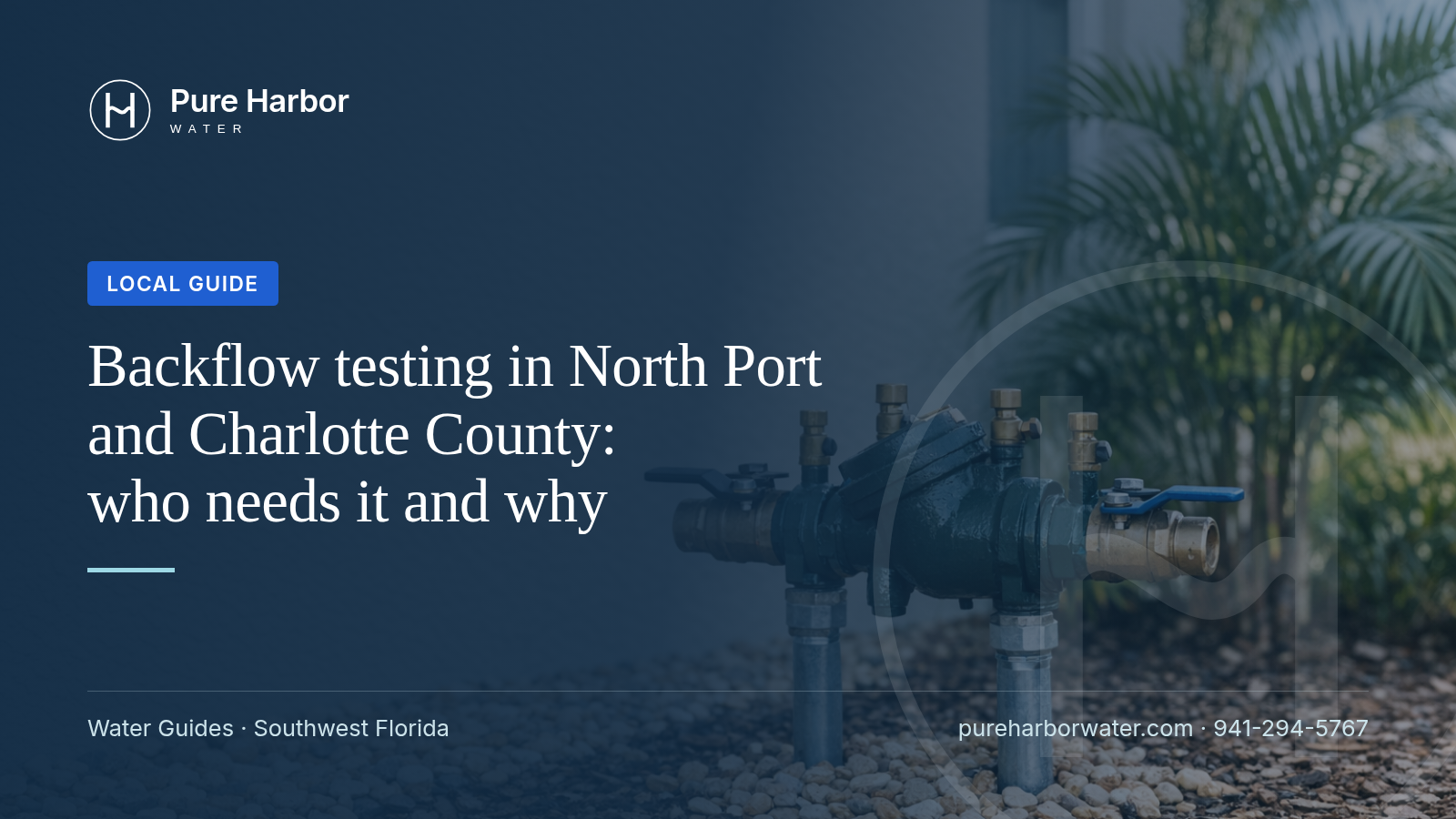
A backflow preventer is a valve assembly near your water meter that stops water from your property flowing backward into the public water main. Florida requires every community water system to run a cross-connection control program (F.A.C. 62-555.360). In North Port, homes with an irrigation system on city water, an irrigation well or reclaimed water need an above-ground, testable device tested at least every 24 months; homes without those have a non-testable dual check replaced every five years (City of North Port). Charlotte County Utilities (CCU) says an assembly must be tested by a State of Florida certified tester when installed or repaired "and annually tested thereafter" (CCU).
FAQ (quick)
- Does the city send someone to test it? Not in North Port. The City says it "DOES NOT send out backflow inspectors" and warns about scams from companies claiming to represent it.
- Who pays and arranges the test? In North Port, the property owner. You hire a state-certified backflow tester, who submits the result to the City.
- I rent. Is it my job? North Port says "the property's legal owner is responsible for all backflow requirements."
- What if I'm not on city water? North Port says residents not connected to City water aren't required by its program to have a device.
- Is this the same as the air gap on my RO faucet? No. That's an under-sink drain fitting. See RO air-gap faucet leaks.
What backflow is, in one minute
Water normally flows from the main, through the meter, into your home. North Port explains that backflow happens "when water is pulled backward due to a pressure loss in the utility water main," such as a main break, a damaged hydrant or heavy firefighting use. A cross-connection is any link between drinking water and something else, like "the common garden hose submerged in a swimming pool."
North Port's examples of household cross-connections include:
- a hose submerged in a pool or bucket,
- a fertilizer or pesticide sprayer on a garden hose,
- a lawn irrigation system with submerged sprinkler heads,
- "a connection made between a private well supply and the water being supplied by a public water system."
Who needs what (North Port)
| Your home | What North Port requires |
|---|---|
| City water, no irrigation system or other water source | At minimum an in-ground, non-testable dual check (under Florida Building Code Section 608), replaced every five years by a certified technician |
| City water plus irrigation on city water, an irrigation well or reclaimed water | Above-ground, testable device, tested at least every 24 months by a certified technician |
| Commercial or multi-family | Testable reduced pressure zone (RPZ) device, tested at least every 12 months |
Source: City of North Port, Cross Connection Control Program.
"My irrigation well isn't connected to my drinking water. Why do I need one?" North Port's answer: "Although your well may not be currently cross-connected, the potential still exists for a cross-connection to occur." That's why a testable device goes after the meter.
North Port sends notices 60 days and 30 days before a test or replacement is due. The tester enters results in the City's online backflow portal (BMP). Since Oct. 1, 2023, the City has charged a $3.50 fee to the customer's account when test results are submitted any other way, so ask your tester whether they're registered with North Port Utilities. A permit is required to install a backflow device (Building Division).
Charlotte County Utilities (Port Charlotte area)
- Testing: CCU says an assembly "must be tested by a State of Florida Certified Tester when installed or repaired and annually tested thereafter," and its Back-flow and Reclaimed Services staff keep a database to track annual testing.
- Who regulates it: CCU lists EPA, FDEP and County Ordinance No. 2007-041.
- Program update on hold: CCU's September 2023 FAQ says the utility plans to own residential backflow devices two inches and smaller, with existing homes switched to an approved RPZ at a change of ownership and new homes getting one during construction. The same FAQ says "the updates are temporarily on hold." If you're buying or selling, ask CCU at 941-764-4300 how it applies to your account (CCU FAQ, PDF).
- Test form and contact: CCU publishes a Backflow Preventer Test and Maintenance Form on its program page. The program office is at the East Port Water Reclamation Facility, 941-764-4589.
What the state rule says
Florida's rule sets the floor; your utility can be stricter (CCU's yearly testing is stricter than the state minimum for homes).
- Each community water system must have a written cross-connection control plan (62-555.360(2)).
- Required assemblies at residential connections must be tested after installation or repair "and at least biennially thereafter"; at non-residential connections, at least annually.
- Dual check devices must be refurbished or replaced "at least once every 5 to 10 years," unless the utility documents that less often is appropriate.
- For a home with an auxiliary water system (the rule's term for water from "a well, pond, lake, spring, stream, river," and also reclaimed water), the minimum at the residential connection is a dual check, as long as there's no known cross-connection. If one is found, the utility must have it eliminated or require stronger protection.
- A dedicated irrigation meter on potable water needs a pressure vacuum breaker or, if backpressure could develop, an RP assembly.
- The rule defines a "residential service connection" as two inches or less, serving a building with only dwelling units.
Your utility's local rules decide what's on your property; North Port, for example, requires a testable device for homes with irrigation wells.
Avoiding backflow test scams
North Port says scams "have been reported in the area of companies claiming to represent the City of North Port, or to have been contracted by the City. This is false." The City has no backflow inspectors or contracted companies. If someone says they're from the City, call North Port Utilities at 941-240-8000. To find a certified tester, North Port points to the Florida Department of Business and Professional Regulation.
Wells, irrigation and your drinking water
If your home has city water and an irrigation well, the backflow device protects the public main, not the water inside your house. If you also drink from a well, that water needs its own testing. See North Port city water vs. well water, testing a private well after moving and well water treatment in North Port.
FAQ
How often is backflow testing required in North Port? At least once every 24 months for residential testable devices, and every 12 months for commercial and multi-family, counted from the last passing test.
How often in Charlotte County? CCU says annually after installation or repair.
Can I hide my backflow preventer with shrubs? North Port says plants shouldn't be closer than two feet, so they don't get in the way of testing or repair. Movable artificial rocks are allowed.
What if my device fails? Florida's rule says required assemblies "shall be repaired if they fail to meet performance standards." Your tester and utility will tell you what's needed.
Does Sarasota County or Venice require backflow testing? Every community water system in Florida must have a cross-connection control program, but we haven't reviewed those utilities' local rules. Check with the utility on your bill. See who supplies my drinking water.
Next step
Have questions about the water inside your home, from a well, softener or drinking-water system? Schedule an in-home water check, or call 941-294-5767. More: North Port service area · Port Charlotte service area · Well water solutions · Related: well and septic setback distances in Florida · Charlotte County hydrant flushing
Sources
Drafted 2026-11-17 (America/New_York). Last fact-checked: 2026-11-17 (America/New_York).
A PRACTICAL NEXT STEP
Well-water planning, explained.
Build a treatment plan around your well, your concerns, and appropriate testing.
Explore this solution