A fresh approach to water. Rooted in North Port, Florida.Call 941-294-5767

NORTH PORT WELL WATER

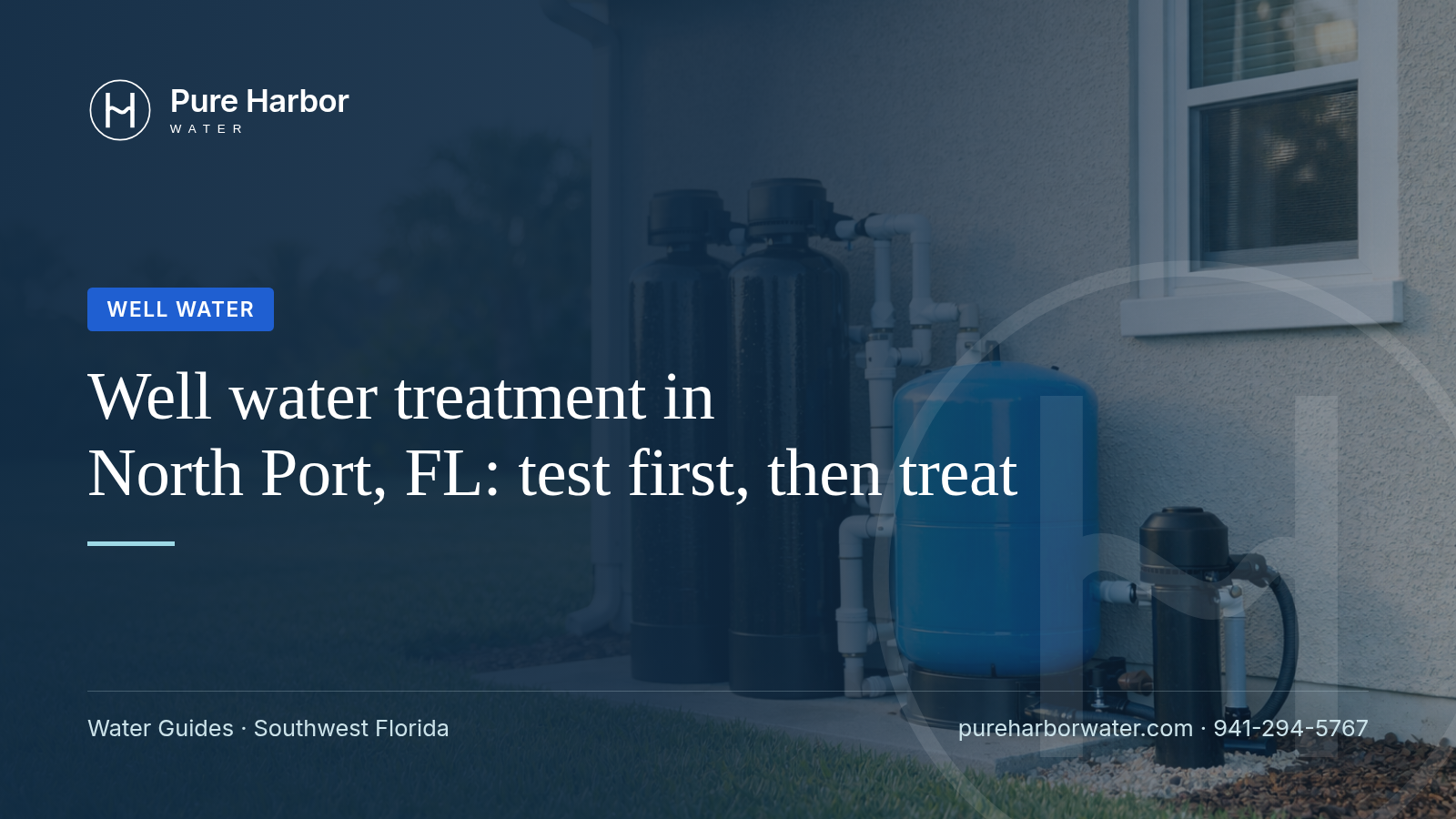
Well water treatment in North Port, FL.
Test first, then treat.

On a private well in North Port? What Florida's health department says to test, how to read odor and stain clues, and how we match treatment to results.

Well water treatment in North Port, FL: test first, then treat

Equipment, address coverage and scheduling are confirmed before booking.

Your starting point.

If your North Port home has a private well, the water's quality is your responsibility, not the city's. The Florida Department of Health strongly recommends testing a private well for bacteria and nitrate at least once a year. In Sarasota County, DOH-Sarasota sells a $20 self-collect test kit, and staff can sometimes collect the sample for an extra $40 (DOH-Sarasota). Treat what the lab and your taps show: sulfur smell, iron stains and hardness each need different equipment. We install well water treatment in North Port from your results.

HAVE THESE READY

  • Recent well lab results, if you have them
  • Notes on smell: rotten-egg or sulfur, and whether it is from the hot tap, the cold tap, or both
  • Notes on stains or color: yellow, orange, red or brown stains, or tea-colored water
  • A hardness reading or lab result, or a note about scale and spotting
Explore the equipment approach
01

FAQ (quick)

  • How do I know if I'm on a well? No water bill from North Port Utilities, plus a well head and pressure tank on the property, usually means a private well.
  • How often should I test? Bacteria and nitrate at least yearly (FL DOH), and again whenever taste, odor or color changes.
  • Where do I get a test kit? DOH-Sarasota: 941-861-6133 (Sarasota office) or 941-861-3310 (Venice office).
  • Why does my well water smell like rotten eggs? Usually hydrogen sulfide or sulfur bacteria. A hot-vs-cold tap check helps find the source.
  • Do you repair well pumps? No. For pumps, casings and well disinfection, call a licensed well contractor. We handle treatment equipment.
02

How common are wells around North Port?

More common than many new residents expect. FL DOH's 2023 drinking water panel for Sarasota County counts 7,961 known and 11,587 likely private-well parcels in the county (FL DOH Sarasota drinking water panel). The panel doesn't break that down by city, so we don't give a North Port count. If you're not sure whether your address is on city water, compare it with North Port city water vs. well water or call North Port Utilities at 941-240-8000.

03

Step 1: test

  • Every year: total coliform/E. coli bacteria and nitrate (FL DOH).
  • Every three years: lead, for most homeowners (FL DOH).
  • When something changes: after a flood, after work on the well, or when taste, odor or color changes. See private well after a flood.
  • For treatment decisions: ask a state-certified lab for hardness, iron, manganese, sulfide (or hydrogen sulfide), pH and total dissolved solids. The health department kit is for safety basics, not equipment sizing.

Statewide, FL DOH says county health departments usually charge $20–30 per sample (FL DOH private wells). The state lab returns bacteria results in about 48 hours (FL DOH BPHL). More: North Port water testing and private well lab sample planning.

04

Step 2: read the clues at your taps

FL DOH's odor and staining fact sheet (PDF) gives a simple sorting guide:

What you noticeLikely cause (FL DOH)Where to look next
Rotten-egg smell only from the hot tapWater heaterHot vs. cold sulfur check
Smell only in softened waterSulfur bacteria in the softenerRotten-egg smell after a softener
Strong at first, fades as water runsSulfur bacteria in the well or plumbingLicensed well contractor, then treatment
Strong and constant, hot and coldHydrogen sulfide in the groundwaterNorth Port sulfur water treatment
Yellow, orange, red or brown stains; red slime in the toilet tankIron bacteriaIron bacteria in Florida wells

FL DOH says sulfur bacteria aren't harmful and the smell usually doesn't reflect how clean the water is. To make sure well water is safe to drink, FL DOH recommends testing it regularly for total coliform bacteria or E. coli, along with the yearly nitrate test. Tea-colored water can also come from tannins; a lab test sorts that out. See tannins in well water.

05

Step 3: match treatment to results

Order matters. On most wells, treatment runs from the well toward the kitchen:

  1. Sediment filtration to protect everything downstream. See sediment filter before water treatment.
  2. Sulfur and iron treatment if your results call for it. FL DOH lists aeration, oxidation and activated carbon for odor.
  3. Disinfection (such as UV) when bacteria are a concern; it doesn't replace fixing a well problem. See what UV water treatment does.
  4. A softener only if a hardness test justifies one. See water softener installation in North Port.
  5. Under-sink RO for drinking and cooking water, for example when nitrate or dissolved solids are your concern. See RO system installation in North Port and nitrate in well water: next steps.

Full equipment overview: well water treatment. After installation, retest to confirm it works: verify water treatment after installation.

Reference: DOH-Sarasota, Test your water

INSTALLATION QUESTIONS

Know what to ask.

Is North Port well water safe to drink?
Only a test of your own well can tell you. Wells near each other can differ.
My bacteria test was positive. Should I buy a filter?
Follow the health department's instructions first. See positive coliform well test.
Do I need a permit to drill or repair a well?
Talk to a licensed well contractor. FL DOH lists Sarasota among the counties where the health department enforces local rules on testing new or repaired wells.
Do watering restrictions apply to my well?
Yes. The Southwest Florida Water Management District's current restrictions apply to well water too. See North Port water restrictions.
What does a well water system cost?
It depends on your test results, water use and the equipment needed. We quote after we see your results. See how to compare water treatment quotes.

Plan with a little more clarity.

All water guides

Local guide

North Port water restrictions: days, hours and what counts

North Port is under once-a-week watering through March 31, 2027. Your watering day, allowed hours, whether wells count, and how to cut water waste indoors.

Read the guide

Local water

North Port city water or a private well: where to start

A practical first step for North Port homeowners comparing drinking-water filters, softeners, and well-water treatment.

Read the guide

Well water

Is Florida well water safe to drink? What Sarasota County owners should test

Private well safety in Sarasota County: what to test yearly, DOH kit pricing that is published, odor clues, and when treatment follows lab results.

Read the guide

Private wells

Before a private-well water test: prepare the right questions

Plan laboratory testing and separate source-water questions from equipment performance.

Read the guide

Well water

Red stains and slime: iron bacteria in Florida wells

Red slime in the toilet tank, orange stains or a swampy smell? Florida DOH explains iron bacteria in wells, how they're treated and what to test first.

Read the guide

Well water

Englewood, FL well water: testing, sulfur smell and who to call

Englewood spans Sarasota and Charlotte counties, so who to call for well testing depends on your side. Testing, odor and treatment answers for well owners.

Read the guide

MAKE ROOM FOR BETTER WATER

Your next chapter
starts with a better glass.

A few simple questions.
A clearer idea of what your home needs.

Find your water solution About a minute. A personal call to help you choose.